
Hot Products
- Request A Quote
Bar Type TFT LCD Display for Compact Equipment
Publish time:2026-10-19 11:39:58
Detailed Product Description
Bar Type TFT LCD Display: Design Options for Space-Constrained Products
Not every electronic product is designed around a conventional rectangular display. Some devices have narrow front panels, elongated control interfaces or limited space for displaying information.
A bar type TFT LCD display can be a suitable option when the product's industrial design requires an elongated display area. The right selection depends on the required aspect ratio, resolution, installation dimensions, viewing conditions and interface compatibility.
HOTDISPLAY offers TFT LCD products in different sizes and form factors, including display solutions that can be evaluated for specialized equipment designs.
What Is a Bar Type TFT LCD Display?
A bar type TFT LCD is an elongated display designed around a relatively narrow active area. Compared with a conventional widescreen format, its shape may better match products that need to present a row of information, status indicators, menus or a specialized graphical interface.
The important design principle is to distinguish the screen's diagonal size from its aspect ratio and physical dimensions. Two displays with similar diagonal measurements may have very different widths, heights and active areas.
For product developers, the mechanical drawing is as important as the product title.
Example of an Elongated TFT LCD
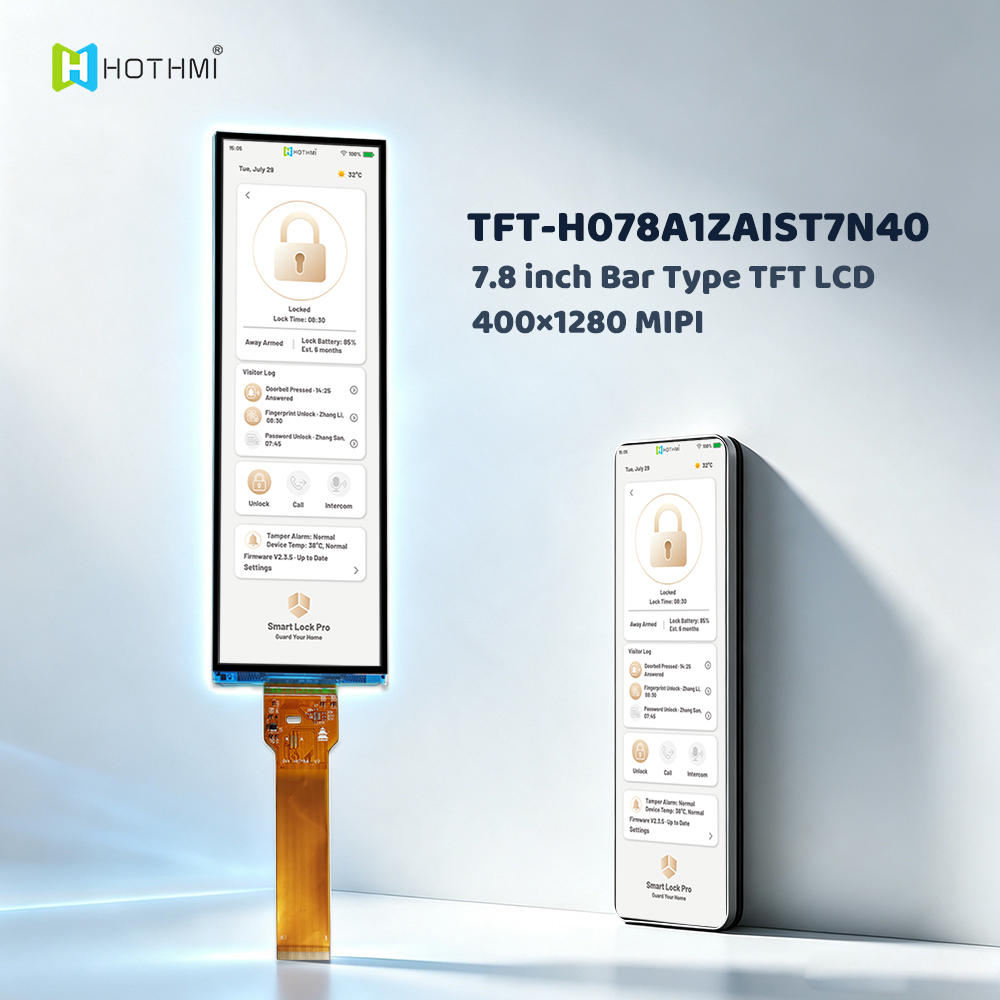
HOTDISPLAY lists a 7.8-inch TFT LCD model with a resolution of 400 × 1280 pixels.
| Parameter | Published specification |
|---|---|
| Display size | 7.8 inches |
| Resolution | 400 × 1280 |
| Outline dimensions | 65.2 × 201.18 × 3.3 mm |
| Active area | 59.4 × 190.08 mm |
| Aspect ratio | 3:1 |
| Viewing angle | Full view |
| Brightness | 750 cd/m² |
| Interface | MIPI DSI |
| Driver IC | ST7703 |
| Operating temperature | -30°C to 80°C |
This example demonstrates how a specialized aspect ratio can support a narrow installation. However, suitability depends on the actual application, enclosure and required display orientation.
Engineers should verify the latest datasheet and confirm whether the displayed resolution, interface and physical dimensions match the intended system.
Where Can an Elongated Display Be Used?
A narrow display format may be considered for equipment that needs a long information area without using a conventional widescreen panel.
Potential design contexts include:
Industrial instruments with narrow front panels.
Equipment interfaces that present sequential status information.
Embedded products with elongated housings.
Specialized control interfaces with a vertical or horizontal information layout.
Products where the visible display shape is a key part of the industrial design.
These are potential application categories, not claims that every bar-type display is suitable for every listed device. Environmental, optical and electrical requirements must still be evaluated.
Five Important Selection Criteria
1. Aspect Ratio and Active Area
Start by defining the required visible area and its orientation. Check both the active area and outline dimensions against the product enclosure.
2. Resolution and UI Layout
Resolution determines the available pixel grid, but the actual user interface must also account for font size, icon dimensions and content arrangement. Software should be designed for the chosen resolution and orientation.
3. Interface Compatibility
Confirm that the host platform supports the selected display interface. The 7.8-inch example above specifies MIPI DSI, which requires compatible host hardware and appropriate display initialization support.
4. Brightness and Viewing Conditions
Evaluate ambient light, viewing distance and the direction from which users will view the display. The required brightness depends on the installation rather than on screen shape alone.
5. Mechanical and Cable Integration
Check mounting points, FPC location, connector orientation, installation depth and clearance around the display. An elongated panel can be difficult to integrate if cable routing is overlooked during enclosure design.
Can a Standard LCD Display Be Customized?
HOTDISPLAY provides display customization services including customized LCD solutions, FPCs, interfaces, touch panels and cover components.
If a standard product does not meet a project's exact dimensions or connection requirements, provide the engineering team with the mechanical drawing, desired active area, resolution, interface and application conditions. The supplier can then assess the available options and the feasibility of the requested configuration.
A custom shape or dimension should not be assumed to be available without engineering confirmation.
Conclusion
Choosing a bar type TFT LCD display begins with the product's actual geometry and user-interface requirements. Aspect ratio, active area, resolution, brightness, interface and cable routing must be evaluated together.
A well-defined specification helps engineers determine whether an existing elongated display fits the project or whether a customized display solution should be explored. Explore TFT LCD Options for Your Product Design with HOTDISPLAY
Hot Articles
Address: No. 22, Xinlesi Rd., Ma 'an Town, HuiCheng District, HuiZhou, 516057, Guangdong, China
- Tel:+86 18929368919
- Email: sales@hothmi.com
- Worktime:9:00-18:30
- Contact Person:Mrs. Dong
- Mobile Site